Microbial terroir
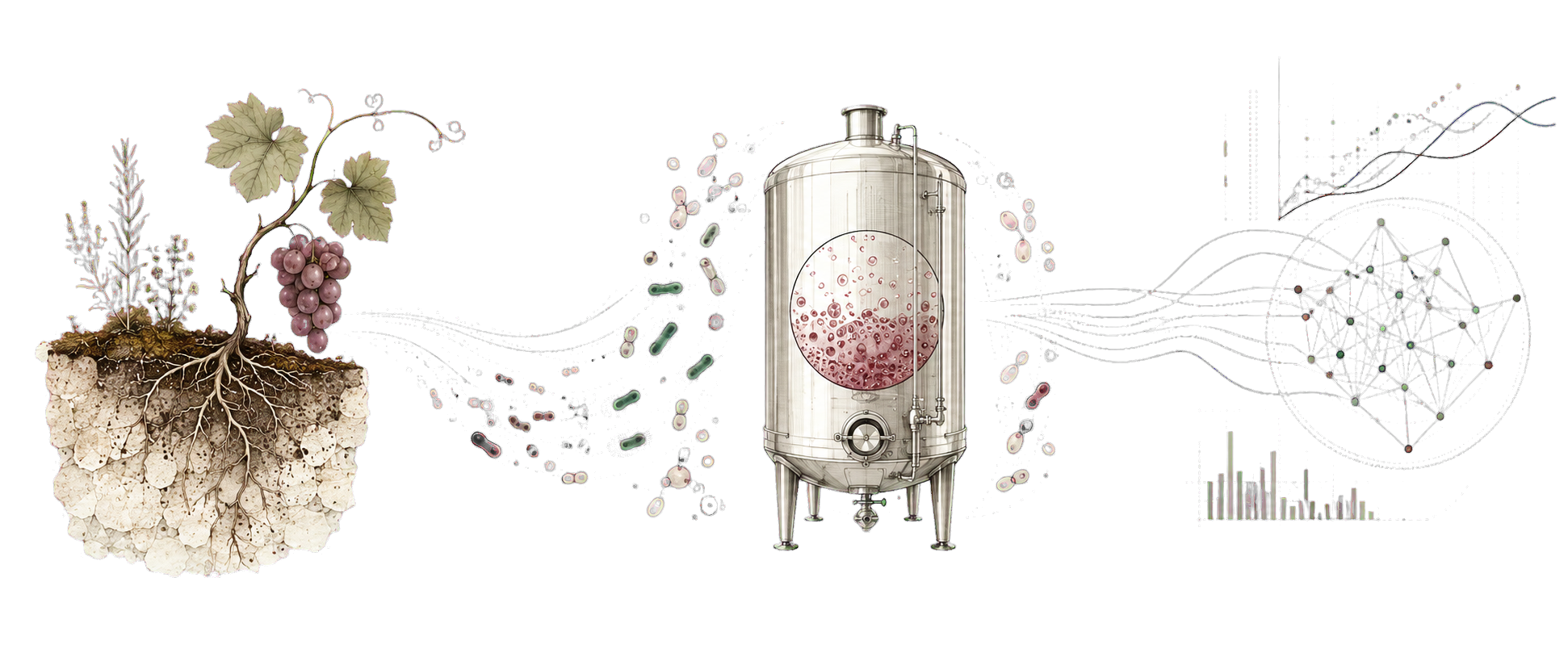
How territory, cultivar, vineyard management and winery practices select microbial communities and functions that contribute to wine identity.
 GIORGIO GARGARIFermOmics Lab
FermOmics · Research
We study who is there, what they can do, how they interact and under which conditions a microbial community leads towards quality, stability or risk.
Research lines
How territory, cultivar, vineyard management and winery practices select microbial communities and functions that contribute to wine identity.
Non-Saccharomyces and Saccharomyces succession, functional turnover and connections with metabolites, aroma precursors and stability.
From the soil–plant–grape–fermentation continuum to the valorisation of microbiomes associated with disease-resistant cultivars and low-input systems.
Pangenomics, metabolic models and experimental validation to understand and select lactic acid bacteria beyond Oenococcus oeni.
Selection and sequential use of non-Saccharomyces yeasts to reduce ethanol while maintaining fermentation completion and volatile acidity control.
Integration of microbial, environmental and process data to anticipate risk, performance and fermentation trajectories.
Multi-omics case
Shotgun metagenomics, untargeted metabolomics and network analysis described the ecological trajectory of spontaneous fermentation and the transition from a non-Saccharomyces-rich community to a Saccharomyces-dominated system adapted to fermentation stress.
Read the studyScience communication
An accessible overview of how metagenomics reveals the microbiome of grapes, must and fermentation—from microbial monitoring and spoilage prevention to wine quality and more predictable process management.
Read the article on InfowineStart with a concrete question
Fermentation, stability, microbial risk, microbiota valorisation or an omics project: together we can define the question, the required data and a realistic experimental pathway.
giorgio.gargari@unimi.it